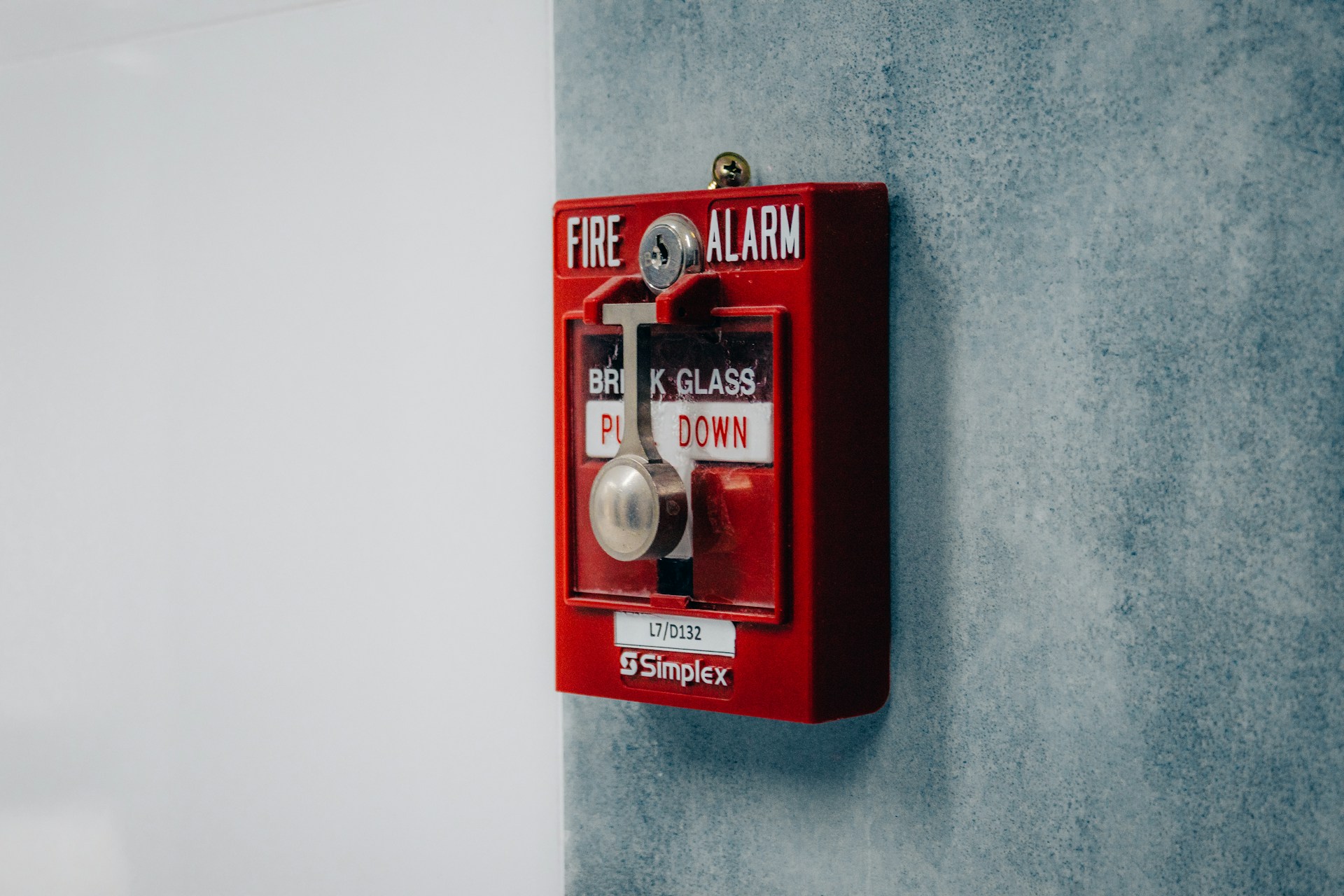
A fire alarm pull station is the red handle mounted by your exits that lets any person in the building start the fire alarm by hand. Pulling it sends a signal to the fire alarm control panel, which sounds the horns and strobes and, on a monitored system, alerts the central station. It is the fastest way to raise the alarm when someone sees a fire before a detector does.
For a facility manager, pull stations look simple, and that is exactly why they get neglected. A station hidden behind a stack of pallets, a cracked housing that drips water onto the switch, or a replacement that does not match the panel can all leave you exposed at inspection time. This guide walks through the types, where codes usually want them, how they should be mounted, and what a proper test looks like.
How a Manual Pull Station Works
Inside the housing sits a switch. When someone pulls the handle, the switch changes state and the panel reads that change as a fire alarm. Everything after that point, from evacuation signals to elevator recall to the call to the monitoring center, comes from the panel's programming.
The handle latches in the pulled position and stays there. That is deliberate. Responders and your staff can walk the floor and see which station started the alarm, and the station cannot simply be pushed back up to hide a prank.
Why buildings need manual activation
Smoke and heat detectors wait for fire products to reach them. In a high-bay warehouse or a big open retail floor, that can take a while. A person standing next to a burning trash can knows right away. Manual stations give that person a way to act, which is why codes treat them as part of the core set of initiating devices in a fire alarm system alongside detectors and sprinkler flow switches.
Single Action vs Dual Action Pull Stations
The first choice is how many motions it takes to activate the station.
A single action station takes one motion: grab the handle and pull down. It is the simplest design for workers wearing gloves, for manufacturing floors and for any space where speed matters most.
A dual action station takes two motions, usually pushing in or lifting a front panel before pulling the handle. That extra step cuts accidental activations from carts, bumped shoulders and curious hands. Schools, healthcare facilities, gyms and busy public buildings often specify dual action for that reason.
Whatever you choose, follow your approved drawings. If the plans call for dual action, a single action unit pulled off the shelf is not an acceptable swap, and the inspector will notice.
Addressable vs Conventional: What the Panel Sees
The second choice depends on your panel, and it matters more than how the station looks.
An addressable station carries its own address. When it activates, the panel display names the exact device, something like "Level 2, North Stair." Your team and the fire department know where to go without searching. A conventional station simply closes a circuit on a zone, so the panel reports "Zone 3 alarm" and someone has to walk the zone to find the pulled handle.
Two stations can look identical and still be useless on each other's systems, because addressable devices speak a manufacturer's own protocol on the signaling loop. Before ordering a replacement, write down the model number from the old device and check it against the panel's list of compatible devices. If you are weighing an upgrade, our breakdown of conventional vs addressable fire alarm systems covers the wider trade-offs.
Where Codes Typically Require Pull Stations
Whether your building needs manual stations at all depends on its occupancy and the building and fire codes your city has adopted. Some fully sprinklered occupancies qualify for exceptions that drop most stations, though at least one usually stays, often near the fire alarm panel or another location the fire marshal approves. Where stations are required, NFPA 72 and NFPA 101 set the placement rules, and your local Authority Having Jurisdiction (AHJ) has the final say.
Near exits and along travel paths
In most installations, a station goes within 5 feet of each exit doorway on every floor, usually on the latch side so people can pull it on their way out. Where a group of doors is wider than 40 feet, a station is typically needed within 5 feet of each side of the opening.
Additional stations fill in so nobody has to walk more than 200 feet on the same floor to reach one. In large warehouses and long office wings, that travel distance is what adds stations mid-floor.
Who approves the layout in the Houston area
Inside city limits, the Houston Fire Department's Fire Marshal's Office reviews and inspects fire alarm work. Unincorporated Harris County addresses fall under the Harris County Fire Marshal's Office, and cities such as Sugar Land, Pearland and Conroe have their own. Confirm which office covers your address before moving or adding a station, because a layout change usually needs approved drawings.
ADA Mounting Height and Clear Access
NFPA 72 places the operable part of the station, meaning the handle, no lower than 42 inches and no higher than 48 inches above the finished floor, which also keeps it inside the ADA reach range. Installers often set the back box so the handle lands near 48 inches, which keeps most models inside that window.
ADA Standards also call for clear floor space in front of the station so a person using a wheelchair can pull up and reach it. Operating force on accessible controls is limited to 5 pounds.
The common failure here is gradual. A vending machine moves in, a coat rack appears, a tenant pushes shelving against the wall. Inspectors write up blocked stations constantly, so make "nothing in front of the red box" part of your monthly walk.
When a pull station needs service
Call a licensed technician when a station is cracked, will not latch, has a sticking handle or shows a trouble signal at the panel. Trouble on a station circuit often points to a wiring fault, a failed module or moisture in the back box. If your stations are overdue for testing or giving the panel grief, Alarm Masters' licensed technicians can inspect, repair and document them as part of your commercial fire alarm system service.
Protective Covers and Weatherproof Stations
If a station keeps getting pulled as a prank or bumped by equipment, a listed protective cover is usually the fix. It is a clear polycarbonate shield that hinges over the station. Many versions sound a loud local horn when the cover is lifted, which startles a prankster and draws attention before the handle is ever touched.
A few cautions apply. The cover must be listed for use with your station model, it must keep the handle within ADA reach and operating limits, and some AHJs want to approve sounder covers specifically, since a person may lift the cover, hear the horn and assume the building alarm is already going.
Outdoors, use stations listed for wet locations. Covered loading docks, parking garages, car wash bays and pool decks around Houston see humidity, wind-driven rain and corrosive air that eat standard indoor plastics. A weatherproof station with a gasketed back box and properly sealed conduit lasts far longer and throws fewer trouble signals after storms.
How Pull Stations Are Tested and Reset
NFPA 72 requires manual stations to be functionally tested, typically once a year as part of the full system test, with visual checks in between. Your AHJ can ask for more.
What a proper functional test includes
- Call the monitoring center and place the account on test, so the test does not send fire trucks.
- Give occupants notice, especially anyone with a medical or sensory sensitivity to horns and strobes.
- Inspect each station for damage, faded instructions, missing covers, loose mounting and blocked access.
- Operate the station using its normal motion, then confirm the panel shows the right address or zone and that the monitoring center received the signal.
- Reset the station and the panel, then confirm with the monitoring center that the account is back in service.
Every result belongs in the inspection report. On an addressable system, a station that reports with the wrong label ("Room 104" when it is really the east stair) is a deficiency worth fixing, since responders rely on that text.
Resetting after a test or an alarm
A pulled station stays latched until someone opens it with the correct key or tool and returns the switch to normal. Keys vary by manufacturer, so keep the right one labeled and stored at the panel. The panel will not clear while any station is still in the pulled position. After a real alarm, wait for the fire department to release the building first, then follow the steps in our guide on how to reset a fire alarm system.
Keep Every Exit Ready for a Fast Alarm
Pull stations only help if they are in the right spot, at the right height and working when someone reaches for one. Alarm Masters holds Texas State Fire Alarm License #ACR-1975 and backs service calls with a 48-hour guaranteed turnaround, so damaged or failing stations do not sit waiting. Our team can test, replace and relabel your devices ahead of your next inspection. Call 281-933-3900 or request a free estimate.
Frequently Asked Questions
Does pulling a fire alarm call the fire department automatically?
Only if the system is monitored. A monitored panel sends the alarm to a central station, which dispatches the fire department. On an unmonitored system the building alarm sounds, but someone still has to dial 911.
Is it illegal to pull a fire alarm when there is no fire?
Yes. Texas law treats knowingly making a false fire alarm report as a criminal offense, and penalties increase when the false alarm involves certain public buildings such as schools. Signage near stations in schools and public venues helps discourage it.
Can we move a pull station during a remodel?
Usually, but the move should be shown on revised drawings and approved by the AHJ before the walls close. The new spot still has to meet the exit distance, travel distance and reach height rules, and the wiring must be extended by a licensed fire alarm contractor.
Why does a pull station come with instructions printed on it?
Listed stations carry simple operating instructions, such as "Pull Down" or "Push, Then Pull," so a stranger can use one in seconds under stress. Replace any station whose printing has faded or been painted over, because inspectors expect the instructions to be readable.
Do pull stations need power to work?
The station itself is a switch and needs no separate power. The panel and the circuit it monitors run on building power with standby batteries, so the station keeps working during an outage as long as the panel batteries are healthy.