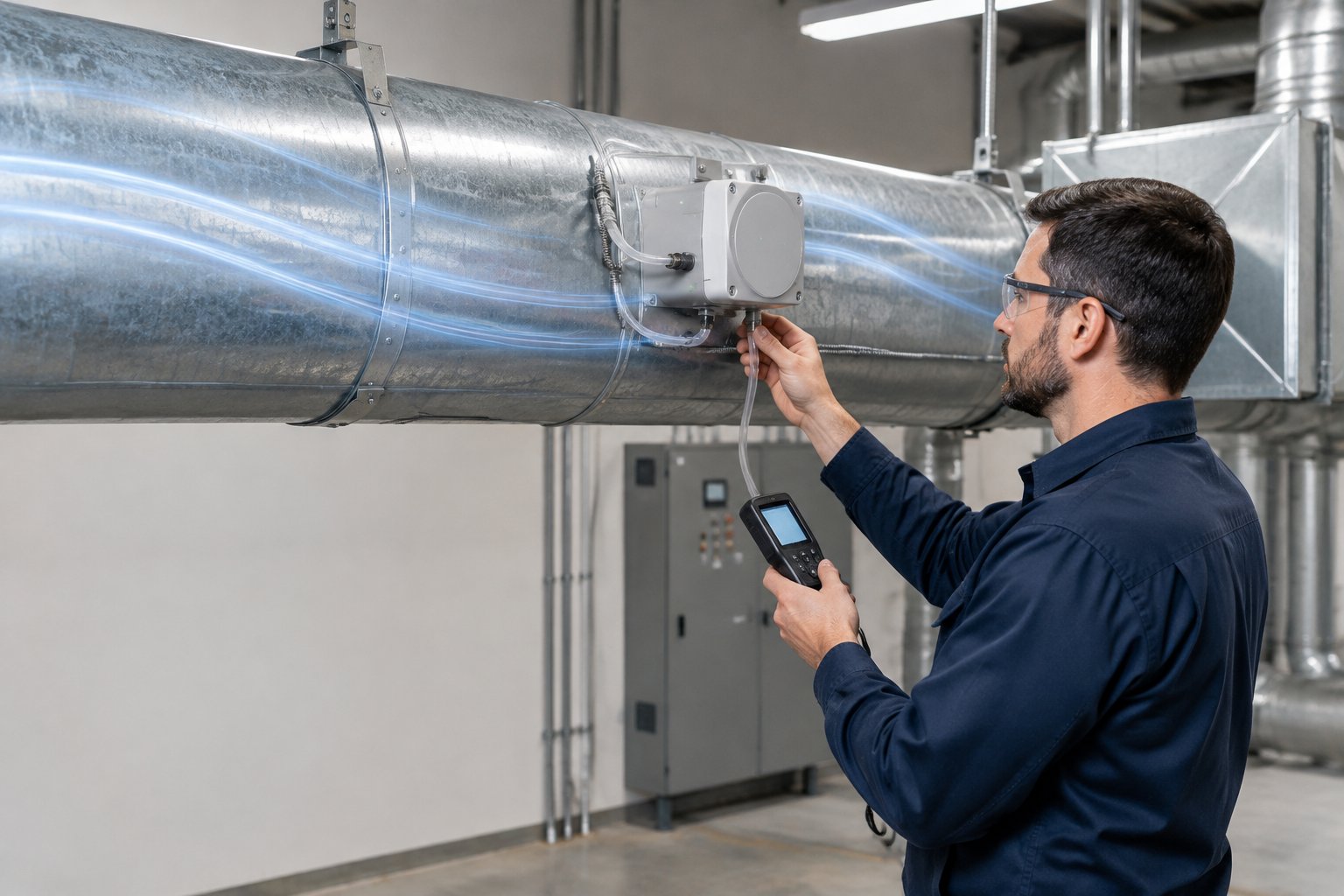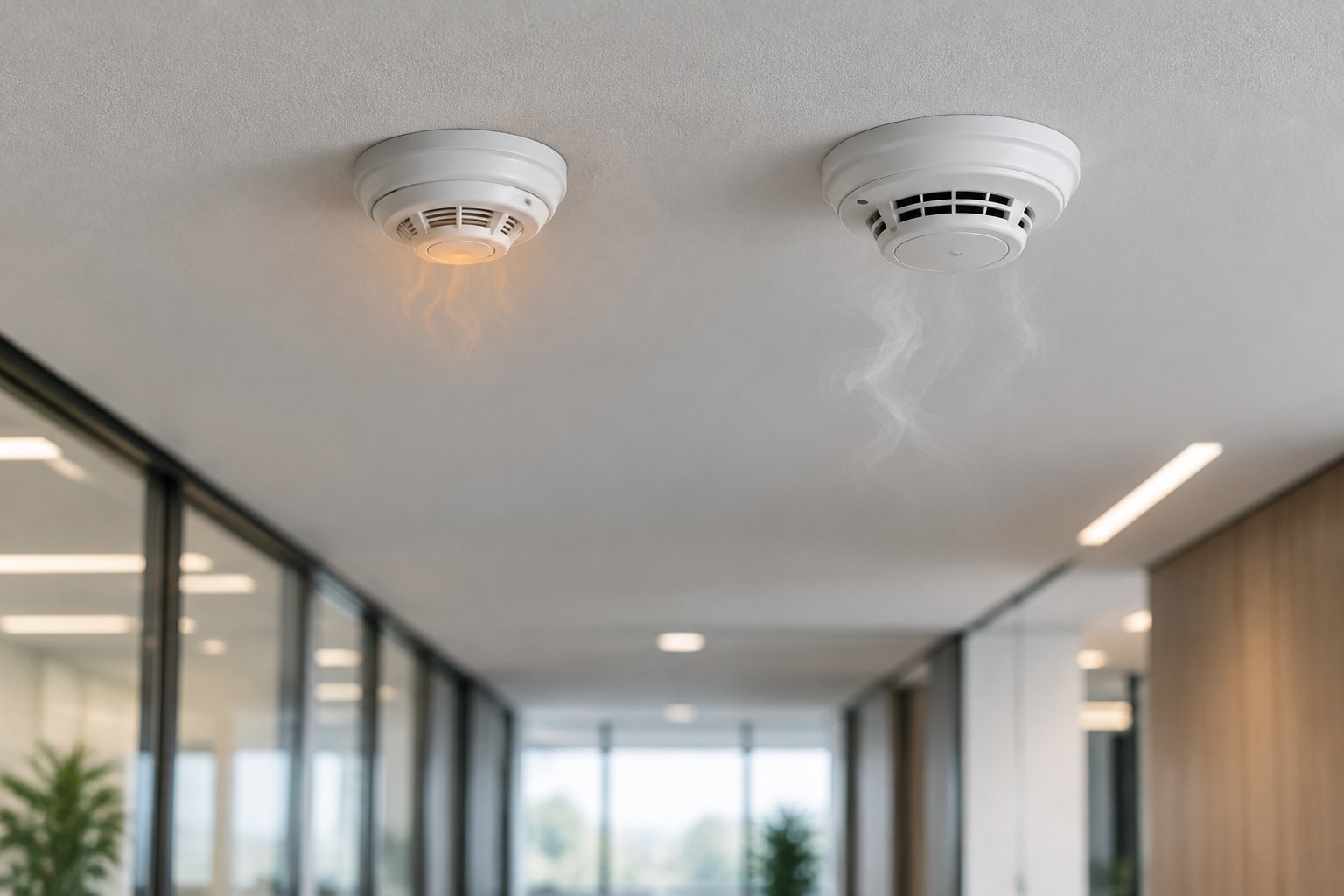
The difference between a heat detector and a smoke detector comes down to what each one senses. A smoke detector reacts to particles in the air and gives the earliest warning of most fires, so it protects people. A heat detector reacts to temperature and ignores smoke, steam and dust, so it fits rooms where a smoke detector would set off constant false alarms.
Most commercial buildings need both. The skill is putting each type in the right room. Get it wrong and you either evacuate the building every time someone burns popcorn in the break room, or you leave a space with a device that reacts too late to protect anyone. In Houston, heat and humidity add a third factor that catches a lot of building owners off guard.
How Each Detector Senses Fire
Most fires produce smoke long before they produce enough heat to warm a room. A smoldering chair, an overheating ballast or a cord pinched behind a desk can fill a space with smoke for many minutes while the air at the ceiling stays near normal temperature.
A smoke detector sees those particles as soon as they reach its chamber. That early warning is what gives people time to get out, which is why codes rely on smoke detection to protect occupants.
A heat detector waits for the fire to grow large enough to push hot gases up to the ceiling. That delay makes it a poor choice for life safety in occupied rooms. It also makes it very stable. Shower steam, cooking vapor, sawdust and vehicle exhaust do not raise the ceiling temperature, so a heat detector simply ignores them.
Heat Detector vs Smoke Detector at a Glance
- Senses: smoke detectors sense airborne particles; heat detectors sense temperature or a fast rise in temperature.
- Warning speed: smoke detectors usually warn first; heat detectors warn later, once the fire is producing real heat.
- Main job: smoke detection protects people; heat detection protects property in spaces where smoke detection is impractical.
- Common nuisance triggers: smoke detectors react to dust, steam, cooking, insects and high humidity; heat detectors react to heaters, ovens and blasts of hot outside air.
- Typical rooms: smoke detectors go in offices, corridors, classrooms, lobbies and sleeping areas; heat detectors go in kitchens, garages, attics, mechanical rooms and dusty work areas.
Types of Heat Detectors
Heat detectors come in two main styles, and many devices combine them.
Fixed temperature
A fixed temperature detector alarms when the air around it reaches a set point. Standard ratings for ordinary rooms are commonly around 135°F, with higher-rated models, often around 190°F to 200°F, made for spaces that run hot, such as boiler rooms, attics and spaces near commercial cooking equipment. Some fixed temperature detectors use a fusible element and do not restore after they operate, so they must be replaced once tripped.
Rate of rise
A rate of rise detector watches how quickly the temperature climbs. Many alarm when the temperature rises about 15°F per minute, which catches a fast flaming fire before the room reaches a fixed set point. Combination heads offer both modes in one device.
Rate of rise is the wrong choice near oven doors, dish machines, dryer exhausts or overhead doors that open from a cool interior onto a 100°F Houston loading dock. Normal temperature swings in those spots trip the device. Fixed temperature only is the better fit there.
Where Heat Detectors Make Sense
Use heat detection where normal activity would fool a smoke detector, and only where the code allows it.
Commercial kitchens and break rooms
Cooking vapor and grease-laden air are the classic smoke detector problem. Restaurants usually rely on heat detection in the kitchen area, with smoke detection in the dining room, corridors and exits. The hood suppression system over the cooking line is a separate system with its own detection, tied to the fire alarm. Our guide to the fire alarm system for restaurants covers how those pieces fit together.
Office break rooms with microwaves and toasters are a smaller version of the same problem. A smoke detector placed right outside a break room door is a frequent source of nuisance alarms, and moving it or changing its type often fixes the issue.
Parking garages, loading docks and shops
Vehicle exhaust, dust and wide temperature swings make smoke detection unreliable in garages, loading docks, auto bays, woodshops and fabrication areas. Heat detectors hold up in those spaces, and outdoor or damp-rated models are available for areas exposed to rain and humidity.
Attics, mechanical rooms and electrical rooms
Unconditioned attics and some mechanical spaces in Houston easily pass 130°F in summer, which exceeds the listed range of most smoke detectors and comes uncomfortably close to a standard 135°F heat detector. Where detection is called for in those spaces, high-temperature heat detectors are the normal choice. Electrical rooms are a judgment call, and many designers prefer smoke detection there because an electrical fire usually smolders first.
Houston Humidity and Nuisance Alarms
Every detector is listed for a range of temperature and humidity, and Gulf Coast weather tests those limits. High humidity and condensation can fog a smoke detector's chamber and trigger an alarm with no fire present. The problem shows up in locker rooms and showers, pool equipment rooms, laundry areas, unconditioned storage rooms and entry vestibules where hot, wet outside air rushes in every time the door opens.
Hurricane season makes it worse. When a storm knocks out power and the building's air conditioning stops, indoor humidity climbs quickly. Dirty or aging smoke detectors are often the first to start alarming during those periods, which is a good reason to keep cleaning and sensitivity testing current before summer.
The fix is rarely to swap in a heat detector everywhere. It is usually better placement, a different smoke detector technology or a multi-sensor device that cross-checks smoke and heat before deciding there is a fire. If nuisance alarms keep disrupting your building, Alarm Masters' licensed team can review device types and locations as part of our commercial fire alarm services.
Why a Heat Detector Cannot Replace Required Smoke Detection
Where the building code, fire code or NFPA 72 requires smoke detection, a heat detector is not an acceptable substitute. Corridors, sleeping rooms, elevator lobbies and many occupied spaces fall into that category depending on the occupancy. Replacing a required smoke detector with a heat detector to stop false alarms leaves people with a late warning and leaves the building out of compliance at the next inspection.
For the bigger picture of how smoke detection protects occupied areas, see our overview of the smoke detector fire alarm system. Your local Authority Having Jurisdiction (AHJ), usually the fire marshal for your address, has the final say on which device type is allowed in each space.
Matching detectors to the panel
Commercial detectors are sensors that report to a fire alarm control panel, and they must be listed as compatible with that panel. Store-bought residential smoke alarms do not belong on a commercial system. Homeowners can apply the same room logic, with smoke alarms in bedrooms and hallways and heat alarms in the garage or kitchen, but commercial devices and residential alarms are not interchangeable.
Put the Right Detector in Every Room
The best detection plan protects people with early smoke warning and keeps nuisance alarms out of kitchens, garages and humid spaces. Alarm Masters has been designing and installing fire alarm systems across Greater Houston since 1990, and our Discovery and Site Walk process looks at how each room is really used before choosing devices. Call 281-933-3900 or request a free estimate for a detection layout that fits your building.
Frequently Asked Questions
How can I tell whether a ceiling device is a heat detector or a smoke detector?
Smoke detectors have vents or slots that let air into an internal chamber. Many heat detectors have a solid or finned center and a temperature rating printed on the face or base, such as 135°F. On a commercial system, the panel programming or the as-built drawings also list each device type.
Do heat detectors need testing like smoke detectors?
Yes. NFPA 72 sets inspection and testing frequencies for both. Restorable heat detectors are typically tested with a listed heat source, while non-restorable fixed temperature units are checked mechanically and electrically instead, since applying heat would destroy them.
Are multi-sensor detectors worth the extra cost?
In spaces with frequent nuisance alarms, often yes. A multi-sensor device compares smoke and heat signals before going into alarm, which can cut false alarms near kitchens and showers while keeping early warning. Your designer and AHJ need to approve its use where smoke detection is required.
Does a heat detector turn on the sprinklers?
No. In a standard wet sprinkler system, each sprinkler head opens on its own when its heat-sensitive element operates. The fire alarm detects the water flow through a waterflow switch. Pre-action and kitchen suppression systems are different and use their own listed detection and controls.
Which type is better for a warehouse with high ceilings?
Neither spot type is ideal at very high ceilings, because smoke and heat both take time to reach the roof. Tall warehouses often use projected beam or air-sampling smoke detection, along with sprinklers, so the design should be based on ceiling height, storage and airflow.