A duct detector is a smoke detector mounted on your HVAC ductwork that samples the air moving through the duct. When it senses smoke, it shuts down the air handler and signals the fire alarm panel, so your HVAC system stops spreading smoke through the building. Larger air handlers, typically those moving more than 2,000 cubic feet per minute (CFM), usually need one.
Most facility managers rarely see their duct detectors. They sit on rooftop units, above ceiling tiles and inside mechanical rooms, which is exactly why they are among the most common items on an inspection deficiency list. This guide covers what they do, which systems need them, where they go, why they throw trouble signals, and how they should be tested.
What a Duct Detector Does
Your air handler is very good at moving air from one place to every other place. In a fire, that means it is also very good at moving smoke. A duct detector's job is to stop that. It is a smoke control device, and it supports your room smoke detectors rather than replacing them.
How it samples air
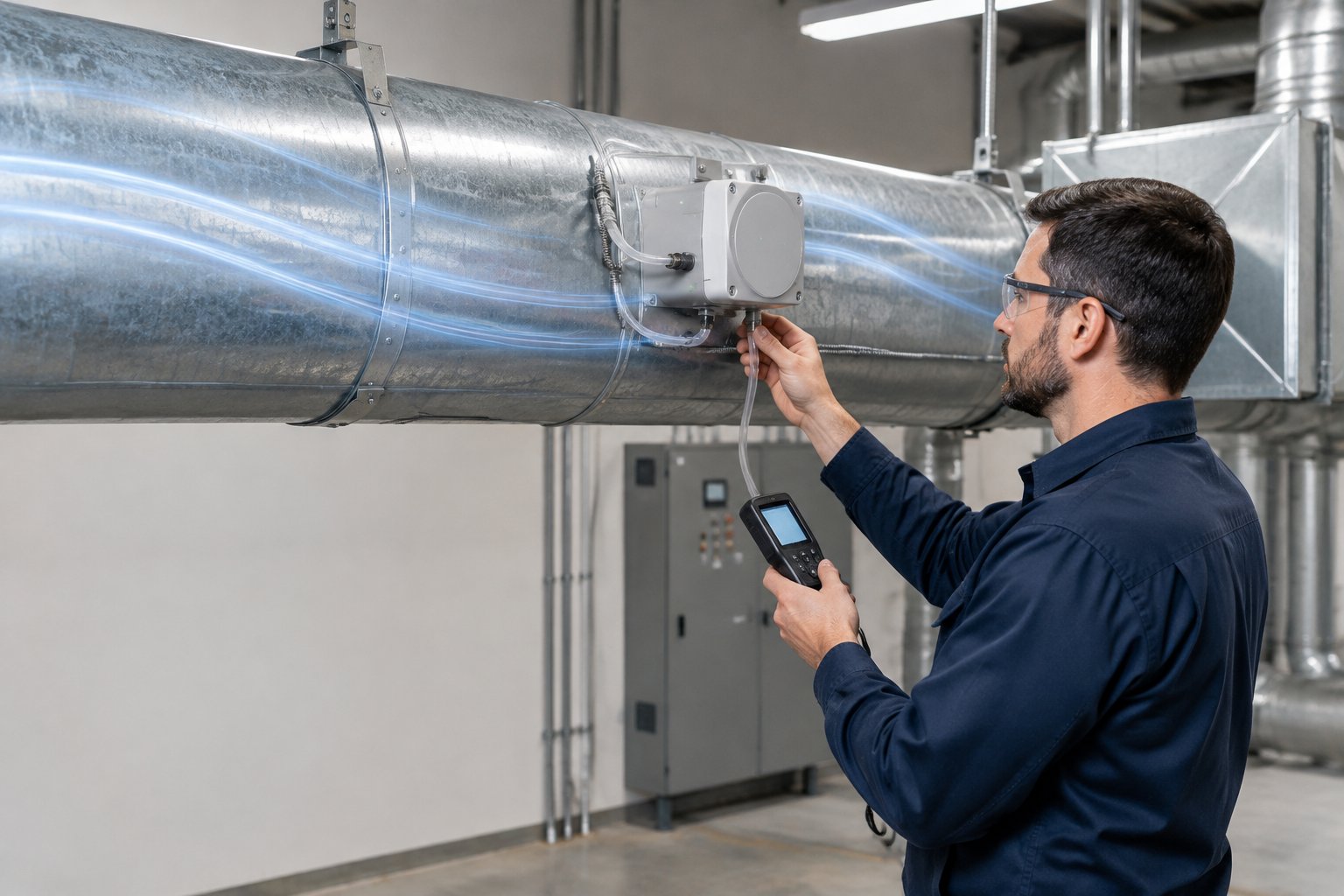
The detector housing mounts on the outside of the duct. A sampling tube with a row of holes runs across the inside of the duct, and moving air pushes into those holes, through the sensing chamber and back out through a shorter exhaust tube. The detector depends entirely on that airflow, which is why tube orientation and air speed matter so much.
What happens when it trips
When smoke reaches the chamber, the detector opens a relay that stops the supply fan, and in larger systems it may also close smoke dampers or start smoke control equipment. It also reports to the fire alarm control panel. Depending on your design and your AHJ, that signal comes in as either a full alarm or a supervisory signal, which alerts staff and the monitoring center without sounding evacuation horns.
Why it cannot replace room detection
Duct air mixes a little smoke with a lot of clean air. That dilution makes a duct detector far slower to sense a small fire than a ceiling detector in the room where the fire starts. Codes recognize this, so duct detectors never count as area smoke detection. Rooms that need smoke detectors still need their own; see how a smoke detector fire alarm system covers occupied spaces.
When HVAC Systems Typically Need Duct Smoke Detection
The requirement comes from the mechanical code and fire codes your city has adopted, not from the fire alarm code alone. Two documents drive most of it.
The International Mechanical Code (IMC), adopted across much of Texas, typically requires smoke detectors in the return air of systems over 2,000 CFM, and additional return-side detection at each story for larger multistory return systems. NFPA 90A, which many fire codes reference, focuses on the supply side of systems over 2,000 CFM. A few points catch owners out:
- Several smaller units sharing common ductwork can add up past the threshold.
- Some exceptions apply when the whole area served by the unit already has area smoke detection tied to the fire alarm.
- When the building and fire inspectors read the codes differently, some projects end up with detectors on both supply and return.
Your local Authority Having Jurisdiction (AHJ) makes the final call. In Houston, that is the City of Houston's building and fire officials; in unincorporated Harris County and suburban communities such as The Woodlands, Katy or League City, it may be a different office with a different code edition. Confirm the requirement with your mechanical engineer and AHJ before buying equipment.
Supply vs Return: Where Duct Detectors Go
Placement follows the job each detector is meant to do.
Supply side
A supply detector catches smoke generated at or near the air handler itself, such as a burning belt, a failed motor or a fire in the filter bank. It typically goes downstream of the filters and ahead of the first branch, so it shuts the fan down before smoke reaches every room on the system.
Return side
A return detector catches smoke pulled out of the occupied space. It stops the system from recirculating smoke from one floor or tenant space to the rest of the building. It typically goes before the return air mixes with outside air.
Airflow and access
Every duct detector is listed for a range of air velocities. Too close to a fan, elbow or damper and the turbulent air can starve or flood the chamber. Most manufacturers want the detector on a straight section of duct, several duct widths away from disruptions.
Access matters just as much. Code expects each detector to be reachable for service. The one buried above a hard ceiling behind a sprinkler main is the one nobody cleans, and it usually shows up as a repeat trouble signal.
Rooftop units and Houston weather
Rooftop air handlers in Houston bake in summer sun, sit in high humidity most of the year and take sideways rain during storms. Detectors and housings mounted outdoors need to be listed for that environment, with sealed conduit entries and tight duct penetrations. Moisture getting into a housing is one of the most common causes of nuisance trips after heavy weather.
Common Duct Detector Trouble and False Alarms
When a duct detector misbehaves, the cause is usually one of a handful of things.
Dirty sampling tubes and chambers come first. Dust, lint and debris clog the tube holes and coat the chamber. The detector either loses sensitivity or drifts toward alarm, and many models report a maintenance or dirty condition before that point.
Low or wrong airflow is next. Clogged filters, a slowed fan, a variable speed drive at low output or an economizer setting can drop air velocity below the listed range. A tube installed backward, cut too short or missing its end cap produces the same result.
Moisture and temperature cause the third group of problems. Condensation near cooling coils or water entry on rooftop units can produce nuisance alarms that seem random until someone looks at the weather history. Our article on fire alarm system false alarm issues covers how to track down repeat nuisance alarms across the rest of the system.
Finally, a detector that alarms correctly but does not stop the fan points to the shutdown wiring, a relay, a motor starter or the HVAC controls. That is a coordination problem between the fire alarm and mechanical contractors, and it is one of the more serious findings on an inspection.
If your duct detectors keep throwing trouble signals or your last inspection flagged them, Alarm Masters can clean, test and repair them and document the results through our fire alarm inspection service.
How Duct Detectors Should Be Tested
A good test proves the whole chain: smoke can reach the chamber, the panel receives the right signal and the fan actually stops.
- Put the monitoring account on test and let occupants and the HVAC contractor know.
- Inspect the sampling and exhaust tubes for damage, blocked holes, missing end caps and correct orientation.
- Check airflow through the detector using the manufacturer's method, often a pressure differential reading across the tubes.
- Introduce listed test aerosol or smoke into the detector as the manufacturer directs.
- Confirm the panel shows the correct device and label, such as "RTU-4 Supply Duct," and the right signal type.
- Confirm the fan shuts down, any dampers close and the remote indicator lights.
- Reset the detector, the panel and the HVAC equipment, and confirm the unit restarts.
NFPA 72 sets the inspection and testing frequencies, and your AHJ can add to them. Our overview of fire alarm system inspection requirements explains how duct detectors fit into the annual schedule.
Remote test stations
A remote test station is a small plate with a key switch or magnet test point and an indicator light, wired to a hard-to-reach detector. It lets a technician confirm the electronics and signal path from the floor. It does not prove that smoke can travel through the tubes into the chamber, so it does not replace the hands-on smoke test the manufacturer and NFPA 72 call for.
Keep Smoke Out of Your Air System
Duct detectors protect a building only when the tubes are clean, the airflow is right and the fan really shuts down. When one starts throwing trouble signals, Alarm Masters offers a 48-hour guaranteed service turnaround ("See you tomorrow") and licensed technicians who test the full shutdown sequence from smoke entry to fan stop. Call 281-933-3900, schedule service or request a free estimate.
Frequently Asked Questions
What should staff do when a duct detector goes into alarm?
Treat it as a possible fire until proven otherwise. Check the air handler and the spaces it serves, and call 911 if anyone sees or smells smoke. Do not reset the system just to get the air conditioning back before someone finds the cause.
Can we bypass a duct detector that keeps tripping?
No. Disabling or bypassing it removes a code-required smoke control function and can leave your building out of compliance. If a detector trips repeatedly, have it cleaned, checked for airflow and repaired, and notify your monitoring center while the system is impaired.
Who installs duct detectors, the HVAC contractor or the fire alarm contractor?
Often both. The mechanical contractor typically cuts the duct and mounts the housing and tubes, while a licensed fire alarm contractor wires it to the panel, programs it and connects the fan shutdown. Clear coordination between the two avoids the common failure where the detector alarms but the fan keeps running.
Why does the HVAC unit not restart after the alarm clears?
Many systems latch the fan shutdown until both the fire alarm panel and the HVAC controls are reset. Some units also need a manual reset at the equipment. Your technician should label which reset restores the unit so staff are not guessing during a hot Houston afternoon.
Do duct detectors need cleaning between inspections?
In dusty buildings, kitchens, warehouses and older systems with poor filtration, yes. Many owners have tubes and chambers checked whenever the HVAC contractor changes filters, which catches buildup before it turns into a trouble signal.