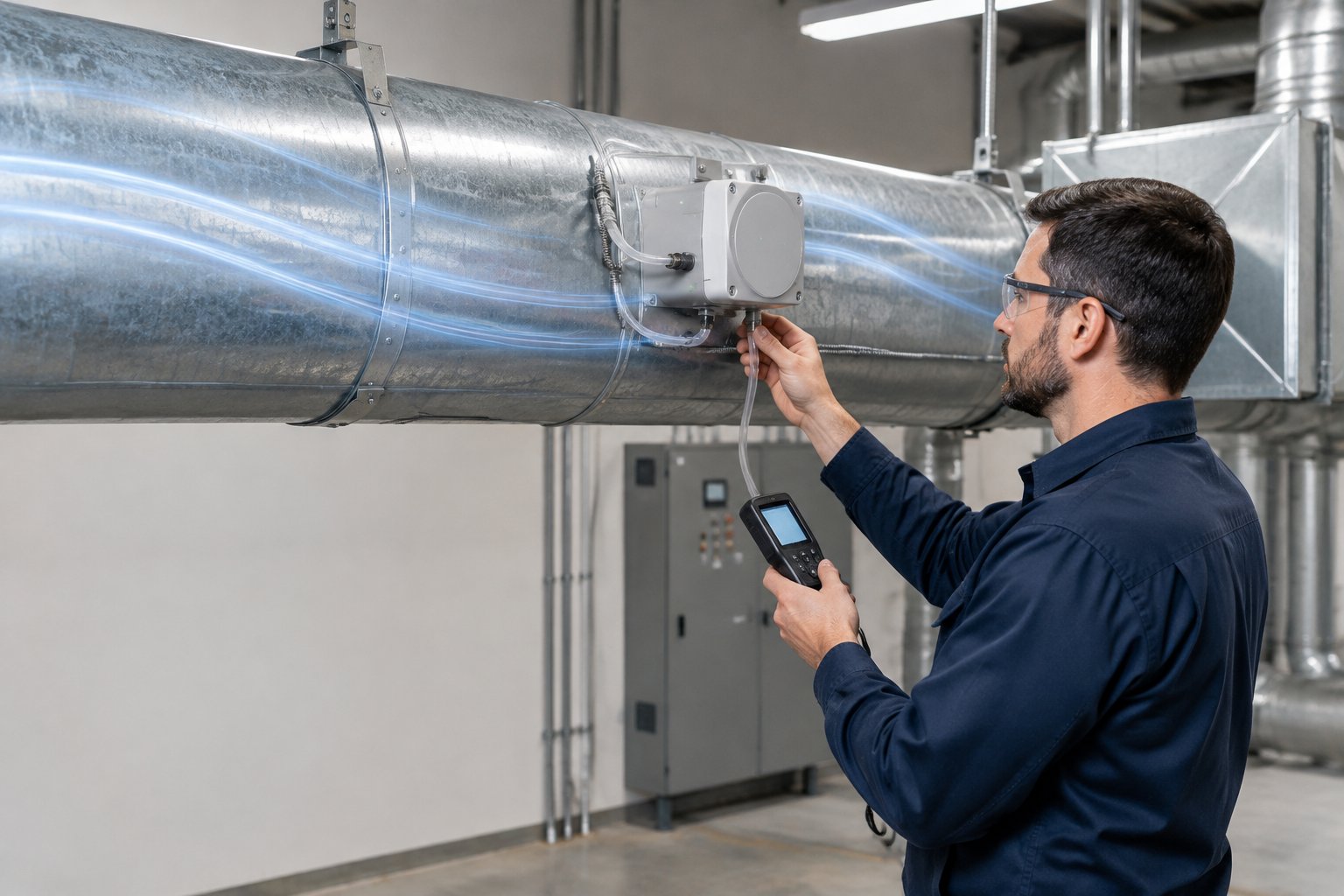
A beam detector is a smoke detector that projects an infrared beam across a large open space and goes into alarm when smoke dims that beam. One unit can cover an area that would otherwise need many ceiling-mounted spot detectors, and it mounts on a wall or column instead of a roof deck 40 feet up. That makes it the go-to choice for warehouses, atriums, churches, gyms and other tall, wide rooms.
For owners of those buildings, the appeal is practical. Spot detectors at high ceilings are expensive to install, need a lift for every test and can miss smoke that cools and spreads before it reaches the roof. A well-designed beam layout solves those problems, provided it is mounted solidly and kept clean. This guide explains how beam detection works, where it fits, what to plan before installation and how to keep it from crying wolf in a humid Houston building.
How a Beam Detector Works
The transmitter sends a steady infrared beam toward a receiver. In clean air, the receiver sees a consistent signal. When smoke drifts into the path, particles scatter and absorb some of that light, and the signal drops. Once the loss crosses a set threshold (called obscuration) and holds there for a set time, the detector reports a fire alarm to the panel.
The detector also tells the difference between smoke and a blocked beam. Smoke dims the signal gradually. A forklift mast or a pallet lifted into the path cuts it off almost completely and almost instantly, which the detector reports as a trouble condition. That logic is what keeps a passing lift from evacuating your building.
Most units let the technician set sensitivity to match the room, so a clean sanctuary and a dusty distribution center can each run at a sensible level.
Reflector vs End-to-End Beam Detectors
Beam detectors come in two styles, and the choice affects wiring, cost and maintenance.
A reflective (single-ended) beam detector houses the transmitter and receiver in one unit. It aims the beam at a passive reflector on the far wall, and the reflector bounces it back. Only one end needs power and wiring, which saves labor in wide buildings. This is the most common type in warehouses.
An end-to-end (projected) beam detector puts the transmitter on one wall and the receiver on the opposite wall. Both ends need power and wiring. These suit very long runs or locations where a reflector would be hard to mount or keep clean.
Both types come in conventional and addressable versions. The detector, or its interface module, must be listed as compatible with your panel. Addressable models report their exact location, which helps a lot when a building has a dozen beams.
Where Beam Detection Fits Best
Beam detectors need a clear line of sight from end to end and a stable surface at each end. They work best in large open volumes with high ceilings.
Warehouses and distribution centers
Long bays and high roof decks are the classic fit. Beams mount on walls or structural columns, so testing does not require a lift over stored goods. In racked warehouses, beams often work alongside sprinklers and heat detection, with the beam covering the open volume above the racks. For a broader comparison of detection options, see our guide to the best fire alarm system for large buildings.
Atriums, churches and gyms
These spaces share tall, open ceilings that are hard to reach and often architecturally finished. Beams mount at the room's edges, out of sight lines and away from decorative ceilings. Many churches in the Houston area have tall wood ceilings and sanctuaries used only a few days a week, which makes reliable detection without frequent ceiling access especially valuable. Gyms with exposed trusses and natatoriums benefit for the same reasons, although pool humidity needs special attention, covered below.
Atriums with glass roofs need careful design because sun-heated air near the roof changes how smoke rises.
When beams are the wrong tool
Small rooms, corridors and spaces broken up by walls are better served by spot detectors. Beams also struggle where the path will be blocked often: overhead cranes, hanging banners, stacked inventory that changes height or scissor lifts that park in the same spot every day.
What to Plan Before Installation
Most beam detector problems trace back to choices made before the first unit was hung. A good design walk covers four things.
Stable mounting
Metal buildings move. Steel expands in afternoon heat and contracts overnight, and a detector bolted to a light-gauge wall girt or purlin can drift off target as the day cycles. Solid columns, masonry walls and heavy structural steel make better mounts. The reflector needs an equally rigid surface, kept away from shiny metal or glass that can bounce stray light back to the detector.
Height and stratification
In a hot, unconditioned Texas warehouse, a layer of very warm air builds under the roof in summer. Smoke from a small fire may cool and stall below that layer, a problem known as stratification. Designers handle it by setting beams at the right depth below the ceiling and, in tall buildings, adding a second level of beams lower down so smoke is caught wherever it settles.
Range and spacing
Each product has a listed minimum and maximum range and a listed side-to-side coverage. NFPA 72 and the manufacturer's instructions set how far apart parallel beams can be and how far the outer beams can sit from the walls. The product must also carry the correct UL listing for projected beam smoke detection.
The future layout
Design for where racks, lights, signs and cranes will be next year as well as today. A beam that was clear on opening day can be blocked by a new mezzanine or a higher rack configuration, which means relocating devices.
Getting these decisions right at the start avoids years of trouble signals. Alarm Masters' fire alarm system design team plans beam layouts around your structure, storage plan and panel so the system is ready for the fire marshal's acceptance test.
Keeping Beam Detectors Reliable in Dusty and Humid Buildings
A well-maintained beam detector can run for years without incident. A neglected one starts throwing faults that staff learn to ignore, which is the worst outcome.
Alignment and signal strength
At commissioning, the technician aligns the beam until the signal strength sits in the manufacturer's recommended range and records that reading. Each later inspection compares the current reading to that baseline. A steady drop points to dirt or drift, and catching it early is far easier than chasing a trouble signal at 3 a.m.
Some models offer motorized auto-alignment and ground-level controllers, which let staff check status and let technicians realign without climbing. Those features are worth considering on very tall ceilings.
Dust, humidity and condensation
Dust coats the lens and reflector over time, and the detector sees that as a slowly weakening signal. Most units include drift compensation, but it has limits. When compensation runs out, you get a trouble signal or, in worse cases, a nuisance alarm.
Houston humidity adds its own risk. On muggy mornings, condensation can fog a lens or reflector near an open dock door, especially after a cool night inside an air-conditioned space. Steam, forklift exhaust and process haze can push readings toward the alarm point. Placing units away from doors, vents and heaters, and cleaning optics on a schedule, prevents most of these calls.
Testing the right way
Testing must follow the manufacturer's method, typically a calibrated test filter placed in front of the lens or a built-in test feature. Spraying aerosol smoke into a beam path across a huge room is unreliable and is not how most manufacturers specify it. NFPA 72 sets inspection and testing frequencies, and each beam's reading and result should be recorded on the report. Many owners fold beam checks into a scheduled fire alarm inspection service so cleaning and alignment never slip.
Get Reliable Detection Above Your Highest Racks
Beam detection works when it is planned around your building and kept clean and aligned. Alarm Masters has designed and serviced fire alarm systems for Houston-area warehouses, churches and commercial buildings since 1990, under Texas State Fire Alarm License #ACR-1975, and our Hypercare Service keeps systems maintained after installation. Call 281-933-3900 or request a free estimate to plan coverage for your space.
Frequently Asked Questions
How far can a beam detector reach?
It depends on the product. Many reflective units cover from about 16 feet to well over 200 feet, and long-range reflector kits push some models past 300 feet. Each model also has a minimum distance, so very short rooms may not suit a beam.
What should staff do when a beam detector shows trouble?
Check the beam path first. A banner, ladder, lift or high-stacked pallet is the usual cause, and clearing it often lets the detector restore. If the trouble returns or will not clear, schedule service, because that part of the building may have no smoke detection until it is fixed.
Can a beam detector work in a natatorium or wash bay?
Sometimes, but moisture is a serious challenge. Condensation on optics can cause trouble signals or nuisance alarms. A designer will check the product's listed environmental range and may recommend a different detection method for very wet spaces.
Do beam detectors need replacing after a building is repainted?
Not usually, but they should be protected during the work and checked afterward. Paint overspray on lenses and reflectors, or dust from sanding, can weaken the signal enough to cause faults. Cover the optics during work and have alignment verified when the project wraps up.
Can a beam detector be added to an existing fire alarm panel?
In many cases, yes, as long as the panel has capacity and the beam (or its interface module) is listed for that panel. Adding devices may also affect battery calculations and require updated drawings and AHJ approval.