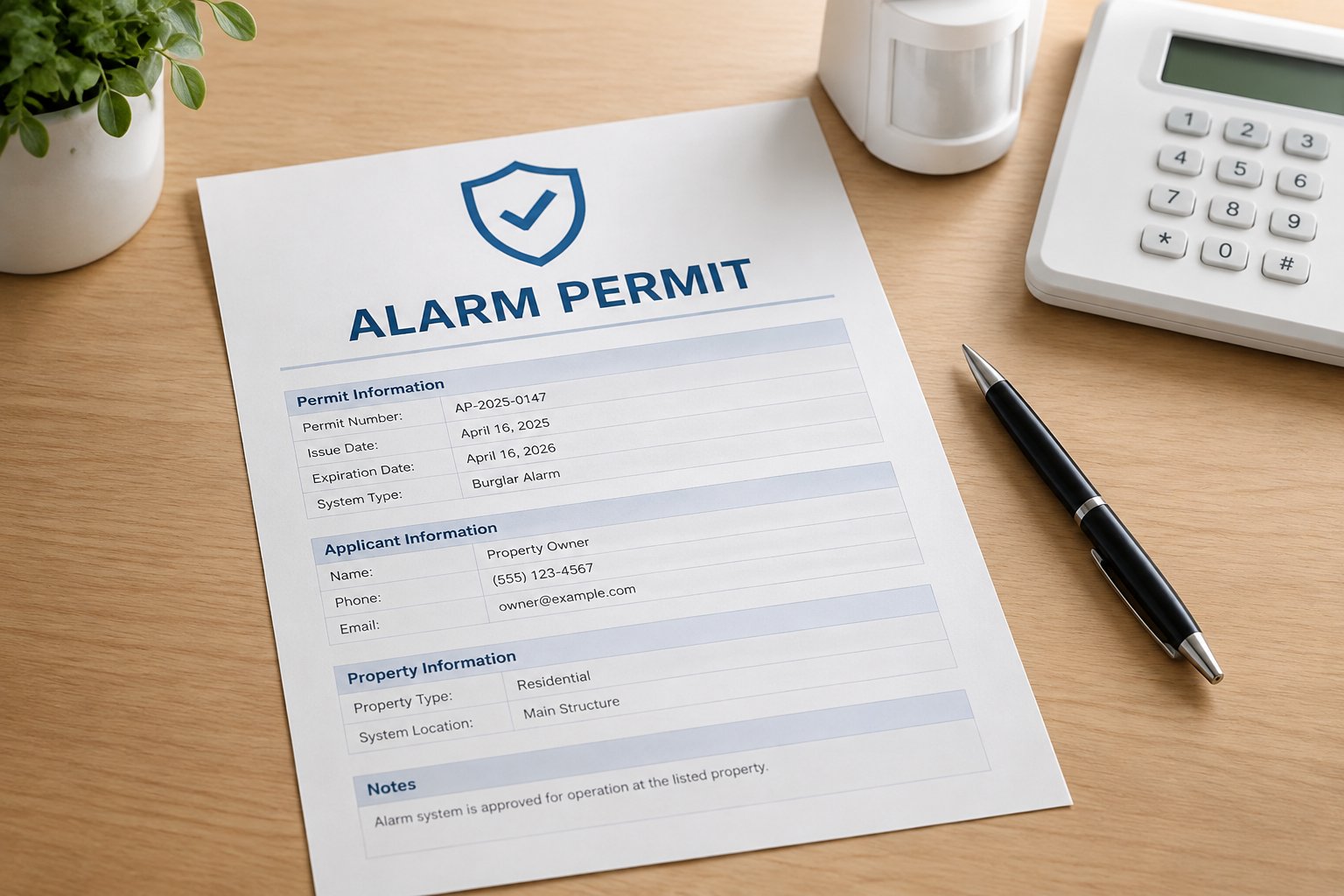
If your home or business sits in unincorporated Harris County and has a monitored alarm, you need an alarm permit from the Harris County Sheriff's Office Alarm Detail. The county's application states that the permit must be issued before the alarm system is activated. Permits cost $40 for a residential site and $100 for a business, last 12 months and renew every year.
That covers a huge share of the Houston area. Neighborhoods across Spring, Cypress, Klein, Atascocita, Huffman and much of greater Katy carry "Houston" or "Spring" mailing addresses but sit outside any city. Their alarms answer to the county, and the county's false alarm charges climb fast. Here is how to confirm your jurisdiction, register, and keep your account clean.
Which Jurisdiction Is Your Property In?
Before you register anywhere, figure out who actually responds to your alarm. Your mailing address and ZIP code will not tell you. A single ZIP code in northwest Harris County can include homes inside Houston city limits, homes in a small incorporated city, and homes in unincorporated territory a few streets apart.
Three quick ways to check
- Look at your property tax statement from the Harris County Appraisal District. It lists every taxing unit for the parcel. If a city appears on the list, the city's rules apply. If no city appears, you are in unincorporated Harris County.
- Think about who shows up. Unincorporated areas are patrolled by the Sheriff's Office or a county constable precinct, while cities have their own police departments.
- Contact the Sheriff's Alarm Detail through its alarm permit website with your address and ask before you file.
Why the county permit is different from the City of Houston permit
Both programs exist to cut false dispatches, but they run on separate rules, separate fees and separate websites. A permit from one does nothing for a property served by the other. One difference stands out for business owners: the county program covers fire alarms as well as security alarms. The Sheriff's application lets you choose a security permit, a fire permit, or a combined security and fire permit, so a commercial building with a monitored fire alarm panel needs to account for it here.
Katy deserves a special mention. The City of Katy is incorporated and has its own police department, but much of the area people call Katy, including large master-planned communities along the Grand Parkway, sits in unincorporated Harris County or in a neighboring county entirely. Fort Bend and Waller County addresses fall outside the Harris County program altogether, so check which county your parcel is in as well.
Who Needs a Harris County Alarm Permit?
Any alarm site in unincorporated Harris County with a monitored burglar or fire alarm needs one, and that includes both homes and businesses. The rule applies whether you own the property or rent it, as long as you operate the alarm.
Fee exemptions that still require a permit
Some sites register without paying the application fee, but every one of them still needs a permit:
- Homes occupied by a permit holder aged 65 or older (this exemption covers the application fee only, not false alarm charges).
- Premises occupied by the U.S. government, the State of Texas or Harris County.
- Publicly funded schools.
Seniors claiming the exemption must register by mail so the county can confirm the applicant's age.
How to Register a New Alarm With the Sheriff's Office
You can register online through the Sheriff's alarm website or by mailing the paper application. Plan to do it before the installer turns on monitoring, not after the first false alarm letter arrives.
What the application asks for
Have the alarmed location's physical address ready, plus a separate mailing address if bills should go somewhere else, which is common for landlords and companies with a central office. You will list the type of permit, your alarm company's details, and two local emergency contacts. The county asks for contacts who can reach the property within one hour to let responders in, secure the building or shut off the alarm, so pick people who live or work nearby.
Online or by mail
On the Sheriff's alarm permit website, choose the option to register a new alarm. The site checks your address against its records. If the location already has an account, it will not let you register as new and will ask you to contact customer service. That happens often after a home sale or when a business moves into a suite that had an alarm before.
To apply by mail, print the Alarm Detail application and send it with a check or money order payable to the Harris County Treasurer. The mailing address is Harris County Alarm Detail, 9418 Jensen Drive, Suite A, Houston, TX 77093. Do not mail cash.
If you received a letter before you registered
Many owners first hear about the program when a false alarm notice shows up. The notice prints an account or permit number above the alarmed location address, with an invoice or reference number at the top. Use those two numbers to sign in on the county site the first time, then set up your account from there.
Renewing and Keeping Your Permit Current
County permits are valid for 12 months and expire on the last day of the twelfth month after issue. The county's application is blunt on one point: not receiving a renewal notice does not excuse a late renewal. Put the date on your calendar.
The application also has you confirm that any fees, fines or court judgments you owe the county under its alarm rules have been paid, so clear old balances before you file. Any change to the information on your application, such as new emergency contacts, a new mailing address or a different alarm company, must be filed with the Alarm Detail within 30 days.
What False Alarms Cost in Unincorporated Harris County
This is where the county program differs most from what many owners expect. According to the Sheriff's current application:
Homes with an active permit
The first false alarm in a permit year carries no charge. The second costs $100, the third costs $200, and each false alarm after that costs $420. Three or four bad nights in a year add up quickly.
Businesses and unpermitted sites
Businesses pay $420 for every false alarm, whether or not they hold a permit, with no free allowance. Unpermitted homes and businesses pay $420 for each false alarm, and the county may also pursue a citation and fine in Justice of the Peace court for operating without a permit.
For a business, that means a door contact that trips every few weeks is a real line item. A single month of sensor trouble can cost more than years of permit fees.
How to Stay Off the False Alarm List
Commercial sites in the county pay from the very first false alarm, so the goal is to stop them before they happen.
Fix the causes that are common out here
Many unincorporated properties are newer tilt-wall warehouses, retail strips and office parks along the Beltway and Grand Parkway, with large open spaces, roll-up doors and HVAC systems that move a lot of air. Motion detectors mounted near supply vents, overhead doors that bounce in the wind, and contacts on doors that settle as a building ages all generate signals nobody intended. Long hurricane season outages drain backup batteries too, and the system can report trouble or alarms when power returns.
A licensed technician who tests each zone, re-aims or replaces nuisance devices and refreshes batteries on a schedule removes most of those problems. If you are near Spring, Klein or The Woodlands, local commercial burglar alarm service in Spring from Alarm Masters can handle that work and keep your site's equipment in shape.
Give the monitoring center a chance to cancel
Monitored systems can call your contacts before requesting a deputy, and that call is your best chance to stop a false dispatch. Keep the contact list short, current and made up of people who answer. Ask about 24/7 alarm monitoring in Spring, Texas with verification options, and make sure everyone with a code knows the cancel steps.
Protect Your County Permit and Your Budget
Your aim is an alarm that stays permitted and only brings deputies when something is wrong. Alarm Masters is based in Spring and has served Harris County homes and businesses since 1990 with a 48-hour guaranteed service turnaround. Our professional alarm monitoring services pair verified alarms with technicians who fix the cause. Call 281-933-3900 or request a free estimate to review your system.
Frequently Asked Questions
Do I need separate county permits for my burglar alarm and my fire alarm?
The county offers a combined security and fire permit, so a site with both systems can cover them on one application. Choose the permit type that matches what is actually monitored at the location.
Does my county permit transfer when I sell my home?
Plan on the buyer registering in their own name. The permit is tied to the permit holder's information, and changes must be filed within 30 days, so the seller should close out their account and the new owner should register before monitoring continues.
My business is in a Katy address but the City of Katy says I am not in city limits. What now?
If your parcel is in Harris County and not inside any city, register with the Harris County Sheriff's Office. If the parcel is actually in Fort Bend or Waller County, contact that county's sheriff instead, since the Harris County program will not apply.
Can I manage my county alarm account online?
The county alarm website lets account holders sign in with an account number and password to manage their account, and you can request a password reset by email. For billing questions or sign-in trouble, contact the Alarm Detail using the customer service details listed on the county alarm permit website.