.svg)

If your warehouse crew cannot hear a shift change announcement over forklift noise, you already know the problem a commercial PA system solves. Maybe your office intercom cuts out mid-sentence, or your church sound system garbles the sermon in the back pews.
Houston property owners running warehouses, schools, retail stores, and offices face this decision constantly: upgrade the paging setup now, or wait until an emergency exposes the gap.
For more than 35 years, Alarm Masters has designed communication systems for Texas properties, from small offices to sprawling distribution centers near the Port of Houston. We know how a commercial PA system should sound in a 200,000-square-foot warehouse versus a quiet medical office, and we build around that difference instead of selling one-size-fits-all equipment.
What Should a Commercial PA System Do in Your Building?
A commercial PA system should handle daily communication and emergency instructions without forcing you to choose between the two.
At its core, a public address system uses microphones, amplifiers, and speakers to increase the volume of a voice or audio source so it reaches a wide area. For a Houston business, that translates into a tool that runs quietly in the background most of the day and then carries urgent instructions clearly when something goes wrong.
Daily Paging, Bell Schedules, Music, and Emergency Instructions
Most commercial buildings use their PA system far more often for routine tasks than for emergencies. Schools rely on bell schedules and classroom paging, retail stores run background music between announcements, and warehouses use overhead paging for shift changes and safety reminders.
A well-designed system switches between these functions without confusion. Staff can page one zone for a spill cleanup while background music keeps playing in the rest of the store, and a scheduled bell can still ring in a classroom during an assembly announcement elsewhere in the building.
Microphones, Amplifiers, Speakers, and Zone Controls
Every commercial PA system depends on the same basic building blocks, though the specific hardware varies by facility type:
- Microphones and paging consoles, which serve as the input point for live or prerecorded announcements
- Amplifiers, which boost the signal enough to drive speakers across a large floor plan
- Speakers, ranging from ceiling units in offices to horn speakers in warehouses
- Zone controls, which let staff send a message to one area without interrupting the whole building
These components work together whether your system uses traditional analog wiring or a network-based digital setup, a distinction that shapes both installation cost and long-term flexibility. Understanding these parts sets up the next decision: how to divide your Houston property into zones that actually make sense.
How Do You Plan Zones and Choose Speakers?
Zoning determines whether your PA system helps daily operations or becomes background noise everyone tunes out.
The goal is to match each zone to how that part of your building is used, then select speakers that perform in that specific environment. A distribution center near Houston's rail and highway corridors has completely different acoustic needs than a two-story office downtown.
Separate Announcements by Area and Purpose
Zoning lets you send a message to a loading dock without disturbing a conference room down the hall. This matters most in mixed-use commercial properties, where a warehouse, office, and retail counter might all share one building.
A common design mistake is creating too many zones for spaces that will always operate identically, which adds cost without benefit, while too few zones forces compromises that annoy everyone. A practical rule for Houston facility managers: plan for one more zone than you think you currently need, since adding one after installation costs more than building it in from the start.
Make Speech Clear in Warehouses, Offices, and Retail Spaces
Speech clarity depends on ceiling height, room shape, and how sound bounces off hard surfaces, not just speaker volume. Speech-heavy spaces like offices and classrooms need tighter speaker spacing to keep announcements intelligible.
Recommended speaker spacing scales with ceiling height:
- 8 to 10 feet: offices and classrooms, spaced 8 to 12 feet apart
- 10 to 14 feet: retail and hospitality spaces, spaced 10 to 14 feet apart
- 14 to 20 feet: warehouses and large retail floors, requiring high-output speakers
- 20 feet and above: industrial sites and atriums, typically using horn-loaded or pendant speakers
Warehouses common across Houston's industrial corridors often need horn speakers and 70-volt or 100-volt amplification to cut through machinery and forklift noise. Offices and retail spaces, by comparison, benefit from ceiling speakers tuned for speech clarity rather than raw output.
Use Weatherproof Speakers for Yards and Parking Areas
Outdoor zones need weatherproof speakers rated to handle Houston's humidity, heat, and storm season. A loading yard, parking lot, or outdoor break area exposed to rain and direct sun needs enclosures built for that environment, not standard indoor units repurposed outside.
Outdoor coverage planning also differs from indoor zoning, since there are no walls or ceilings to contain sound or block wind noise. Getting this right protects your investment and keeps outdoor announcements audible during severe weather, which leads directly into how your PA system should work with the rest of your building's technology.
How Should Paging Connect to Other Building Systems?
Your PA system delivers more value when it works alongside your intercoms, access control, and security cameras, rather than operating as an isolated box in a closet.
Integration reduces the number of separate panels your staff has to manage and lets one event trigger a coordinated response across multiple systems.
Coordinate with Intercoms and Access Control
Connecting your paging system to intercoms and access control lets front desk staff verify a visitor and page a specific department in one motion. Network-based, IP public address systems make this integration more practical because they connect to existing network infrastructure.
This kind of integration also supports video surveillance workflows, where an operator watching a camera feed can issue a live warning through the paging system without switching equipment. For Houston business owners managing liability around trespassing or after-hours activity, that immediate response capability carries real operational value.
Know When a Separate Fire Alarm Voice Evacuation System Is Required
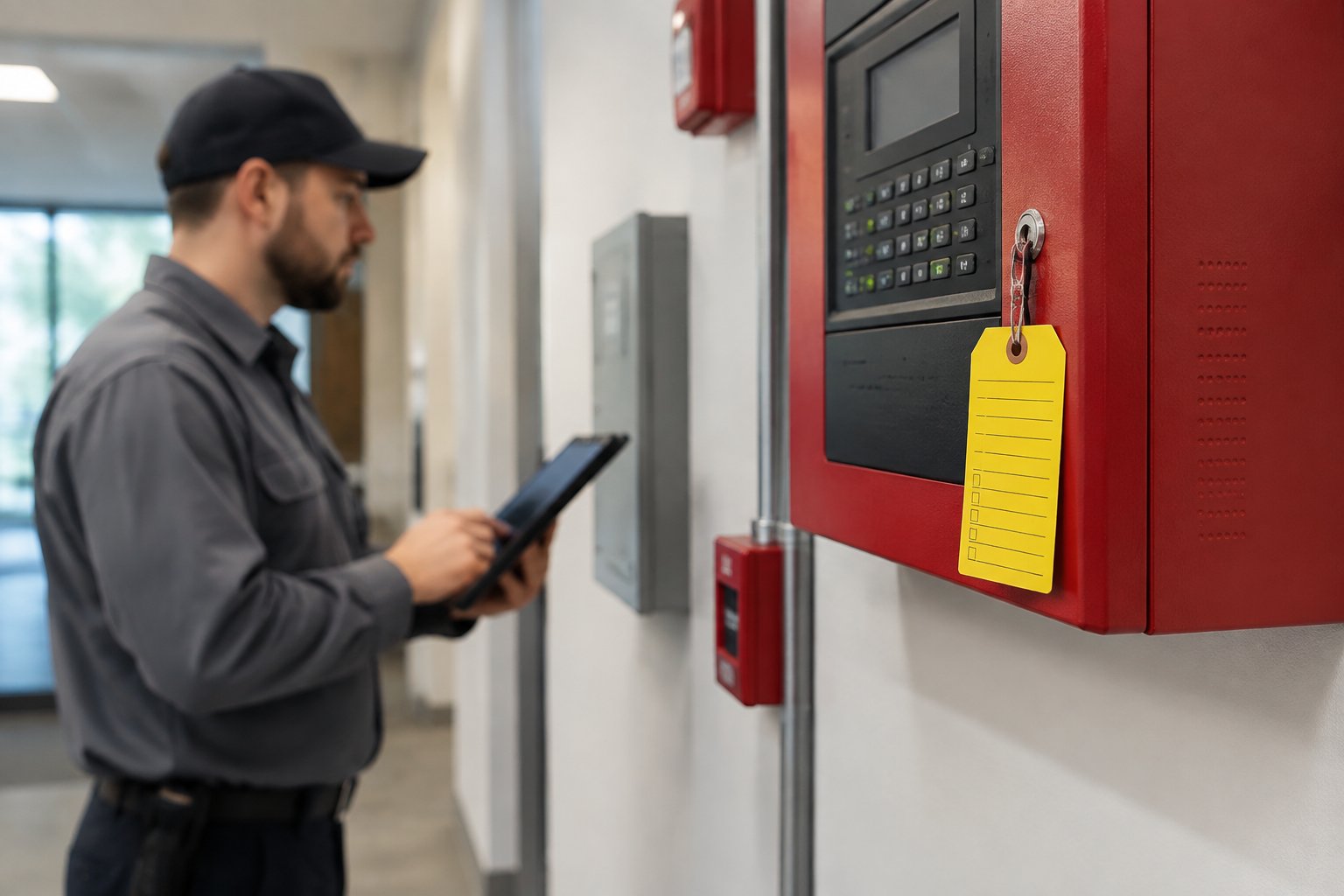
A general commercial PA system does not satisfy Texas fire code and NFPA 72 requirements for voice evacuation in most commercial occupancies. Your fire alarm system needs a voice alarm (or VA) component built specifically to deliver clear evacuation instructions during a fire, backed by dedicated battery power and testing requirements that standard paging equipment does not meet.
The distinction matters because a fire alarm going off in a crowded building creates confusion if there is no clear spoken instruction telling people which exit to use, a gap that voice evacuation systems are designed to close, according to this AVIXA FAQ on PA and voice alarm systems. Voice alarm systems require battery backup and legally mandated recurring testing, unlike a standard paging system.
If your Houston commercial property needs both daily paging and code-compliant fire evacuation, these typically require separate certified equipment working together, not one system doing double duty. Getting this distinction right before installation day avoids a costly retrofit later.
What Should You Check Before Installation?
A successful installation starts with mapping your building, not picking equipment off a spec sheet.
Facility layout, wiring paths, and future growth all shape what system design actually works for your Houston property.
Map Coverage, Noise, Wiring, and Future Expansion
Start by walking the space and noting ceiling height, wall materials, and existing noise sources like HVAC units or production equipment. Hard surfaces such as concrete and glass reflect sound differently than carpeted offices, which changes how speakers should be placed and aimed.
A practical planning process includes:
- Reviewing the size, layout, ceiling height, and surface materials of each space
- Identifying who needs to make announcements and what they need to communicate
- Mapping speaker coverage to avoid dead zones and echo-heavy hot spots
- Selecting amplifiers and controls that match daily operational needs
- Testing speech clarity and volume balance after the equipment goes in
This process mirrors a standard system design approach that starts with how the space gets used rather than which speakers look impressive on paper. Building in extra wiring capacity now costs far less than rewiring later when your Houston property expands or changes use.
Plan Testing, Staff Training, and Maintenance
After installation, test every zone for speech clarity, volume balance, and feedback before calling the project finished. Staff also need basic training so they feel comfortable making a routine page or triggering an emergency announcement without hesitation.
Ongoing maintenance keeps the system reliable over its full lifespan, since components like amplifiers and speaker wiring degrade gradually rather than failing all at once.
Documenting zone layouts and equipment locations also helps whoever services the system down the road, whether that is your own facilities team or an outside technician. With planning and testing complete, the last question is simple: will people actually hear the system when it counts?
Choose a System People Can Hear When It Matters
A commercial PA system earns its cost the moment a clear announcement prevents confusion, whether that is a routine shift change or an unexpected building evacuation.
Speech intelligibility should guide every decision in your system design, more than raw volume or a long feature list. A system that delivers crystal-clear audio with minimal distortion and proper noise compensation ensures announcements get understood the first time.
For Houston properties specifically, that means accounting for warehouse machinery noise, retail foot traffic, and outdoor weather exposure all in the same overall design. A system tuned only for a quiet office will fail in a loud loading dock, and vice versa.
Ready to find out what your property actually needs? Request a free estimate from Alarm Masters, and our licensed team will walk you through every option, from daily paging to how your PA system should work alongside a fire alarm voice evacuation system.
Our team designs, installs, and maintains PA systems alongside security and fire systems, so your Houston property works with one trusted vendor instead of juggling separate contractors.
Frequently Asked Questions
What type of PA speakers work best in a noisy warehouse?
Horn speakers paired with 70-volt or 100-volt amplification typically work best in warehouses because they project sound over long distances and cut through equipment noise. Ceiling speakers common in offices generally lack the output needed for a large warehouse floor with high ceilings.
Can one PA system cover both indoor spaces and outdoor areas?
Yes, one system can cover both, as long as outdoor zones use weatherproof speakers rated for Houston's heat, humidity, and storm exposure. Indoor and outdoor areas should still be set up as separate zones so staff can send announcements to one without disturbing the other.
Can a small office PA system expand as the business grows?
Yes, network-based digital PA systems are built to scale, letting you add zones or speakers as your Houston property grows without a full system overhaul. Planning extra wiring capacity and adding one more zone during the initial installation makes future expansion much simpler.
Can a commercial PA system play music and handle announcements?
Yes, most commercial PA systems support background music and live or scheduled announcements at the same time. Zone controls let you keep music playing in one area while paging a specific department elsewhere in the building.
Does a general PA system satisfy fire alarm voice evacuation requirements?
No, a standard commercial PA system does not meet Texas fire code requirements for voice evacuation in most commercial buildings. A dedicated voice alarm system with battery backup and required testing is needed to deliver code-compliant emergency evacuation instructions.



.svg)


.svg)